
ASSESS
DOCTORAL CANDIDATE 11
Smart FRP Spacecraft Structures Under Cryogenic Conditions
EDUCATION
- BSc. in Mechanical Engineering and Aeronautics - University of Patras, Greece
MSc. in Applied Mechanics, Material Science, and Biomechanics - University of Patras, Greece
PhD in - Dresden University of Technology, Germany
ABOUT
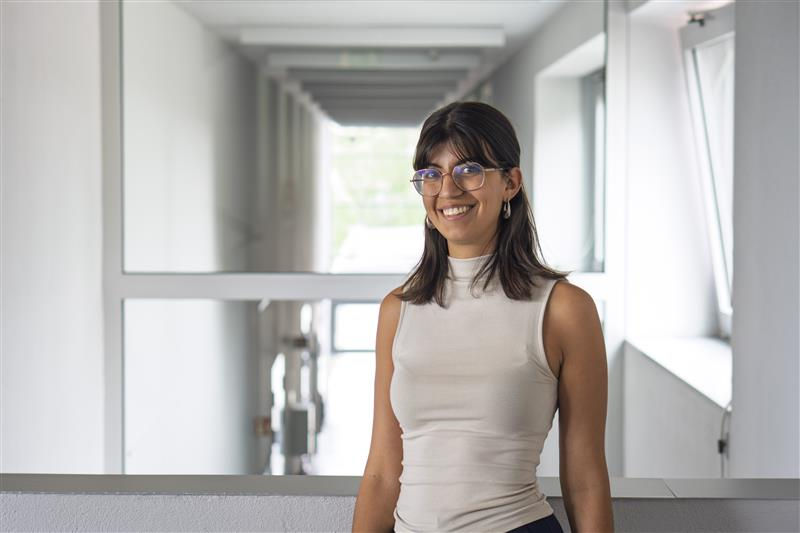
Theodora is a Mechanical Engineer, graduate of the Mechanical Engineering and Aeronautics department, University of Patras with a M.Sc. in Applied Mechanics, Material Science, and Biomechanics. She have always believed that true technological advancement begins at the foundational level: the materials themselves. Lightweight engineering perfectly combines her interest for material science and engineering, bringing them together to create exciting and innovative projects.
Through her research she aims to advance understanding of the behavior of Structural Health Monitoring (SHM) systems in harsh cryogenic and space environments. By investigating the challenges these extreme environmental conditions pose she seeks to contribute to the development of robust SHM data acquisition systems, that ultimately lead to more reliable prognosis models.
02
Objectives
- Integrate piezo based sensor/actuator networks into CFRP structures.
- Exerimental evaluation of smart structures’ capabilities at cryogenic temperatures.
- Support real life model with a High-Fidelity Multi-Physics Numerical Model and creation of virtual datasets for ML-training .
03
Expected results:
- Monitor of spacecraft CFRP structures in cryogenic conditions using TEmSAL smart layer technology.
- Validated Numerical FEM of the smart CFRP strucure.
- Approach for reducing computational demands when generating reliable synthetic training datasets for ML algorithms.
04
Planned secondments:
- European Space Agency (ESA), months 20-25: Testing of integrated sensor elements and circuitry under space coditions (low temperature, vacuum).
- Politecnico di Bari (BARI), Bari, Italy, months 37–42: development of GW-based methods for damage detection and
support with ML algorithms.